
Why Many Private Practices in America Are Profitable on Paper but Struggling With Cash Flow

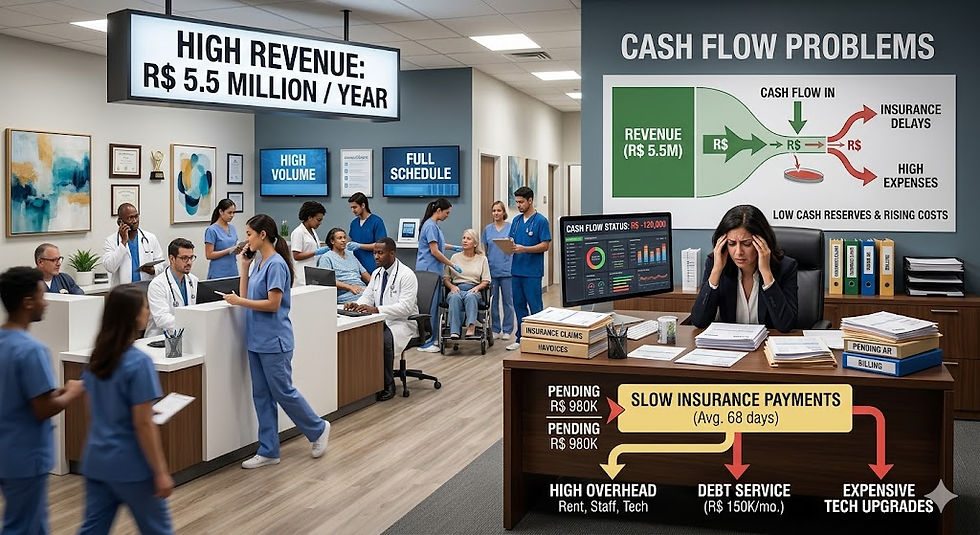
Understanding the hidden financial pressures destroying cash flow in U.S. medical and dental practices despite strong revenue and growing patient volume.
Many healthcare practice owners in the United States are facing a frustrating contradiction: their medical or dental practice appears profitable on financial statements, yet cash constantly feels tight. Revenue may be growing, patient volume may be stable, and production numbers may look impressive, but the bank account tells a very different story.
This issue has become increasingly common across independent medical practices, dental offices, ambulatory care centers, and specialty clinics throughout the U.S. healthcare market. Rising staffing costs, reimbursement pressure from insurance payers, delayed collections, operational inefficiencies, and aggressive growth strategies are creating dangerous cash flow gaps inside practices that technically appear successful.
The problem is that many healthcare owners still evaluate performance primarily through production reports or gross revenue. However, revenue alone does not determine financial health. A practice generating $5 million annually can still face payroll stress, delayed vendor payments, mounting debt, and owner distributions that are financially unsustainable.
In today’s healthcare environment, cash flow management has become just as important as clinical excellence. Practices that fail to understand the difference between profitability and liquidity often experience operational instability long before they recognize the severity of the problem.
This article explores why so many U.S. private practices struggle with cash flow despite appearing profitable, the hidden operational and financial risks behind the issue, and the strategic actions healthcare owners can take to stabilize and improve financial performance.
Profitability Does Not Equal Cash Flow
One of the most dangerous misconceptions in healthcare business is assuming that profitability automatically means financial stability.
A practice can show:
Strong revenue growth
Positive EBITDA
High patient volume
Increasing collections
And still experience:
Payroll stress
Vendor payment delays
Dependence on credit lines
Cash shortages
Owner anxiety
Why?
Because profitability measures accounting performance, while cash flow measures actual money movement inside the business.
The Revenue Illusion in Healthcare Practices
Many U.S. healthcare practices operate under an accrual-based mindset without fully understanding its operational implications.
For example:
A medical practice may bill:
$400,000 this month
But:
Insurance reimbursements may take 30 to 120 days
Patient collections may be delayed
Accounts receivable may continue aging
Refunds and denials may reduce realized revenue
Meanwhile, the practice must immediately pay:
Payroll
Rent
Vendors
Medical supplies
Technology subscriptions
Malpractice insurance
This timing mismatch creates severe cash pressure.
Insurance Reimbursement Delays Are Crushing Liquidity
Insurance dependency remains one of the largest cash flow risks in American healthcare.
Even highly productive practices often struggle because:
Payers delay reimbursements
Claims are denied
Coding errors slow collections
Prior authorizations increase administrative burden
This creates unstable revenue timing.
Practical Example
Practice A — Heavy Insurance Dependency
Monthly production: $600,000
Average reimbursement delay: 60 days
Accounts receivable aging issues
6% claim denial rate
Result:The practice constantly experiences cash pressure despite strong revenue.
Practice B — Balanced Revenue Model
Monthly production: $480,000
Faster collections
Strong cash-pay services
Better payer mix
Lower AR aging
Result:Lower gross revenue but significantly healthier cash flow.
This distinction matters enormously in healthcare valuation and operational sustainability.
Staffing Costs Are Growing Faster Than Revenue
Labor inflation has become one of the most important operational threats for U.S. healthcare practices.
Healthcare staffing shortages continue driving:
Higher wages
Recruitment expenses
Overtime costs
Employee turnover
Burnout-related inefficiencies
In many markets, staffing costs now consume:
30% to 45% of total collections
In some specialty practices, this number is even higher.
Why This Creates Cash Flow Problems
Many practices continue hiring based on projected growth rather than operational efficiency.
As a result:
Payroll expands rapidly
Revenue growth lags behind
Margins compress
Liquidity weakens
The practice may still technically remain profitable, but cash becomes increasingly constrained.
Patient Financing and Extended Payment Plans
Another hidden issue affecting private practices is excessive patient financing.
Many dental and elective medical practices now rely heavily on:
Long-term payment plans
Third-party financing
Extended treatment financing
While this increases case acceptance, it often creates liquidity distortion.
Financial Simulation
Dental Practice Scenario
The practice sells:
$150,000 in treatment plans monthly
However:
70% is financed over 18 months
Providers are paid quickly
Marketing expenses remain high
Collections are delayed
Despite impressive production numbers, actual monthly available cash may be dangerously low.
This is especially common in:
Cosmetic dentistry
Orthodontics
Plastic surgery
Elective medicine
Operational Inefficiency Is Draining Cash Quietly
Many healthcare owners underestimate how operational inefficiency impacts liquidity.
Small inefficiencies compound rapidly.
Examples include:
Excessive no-shows
Poor scheduling utilization
Overtime abuse
Supply waste
Weak inventory management
Underperforming staff
Low treatment acceptance rates
Even profitable practices can experience severe cash erosion due to operational leakage.
The Hidden Danger of Rapid Expansion
Private equity activity and aggressive growth trends have pushed many healthcare owners toward rapid expansion.
Opening:
New locations
Ambulatory centers
Additional operatories
New service lines
May increase long-term valuation potential.
But expansion consumes enormous cash upfront.
Common Expansion Mistakes
Healthcare owners often:
Overestimate patient growth
Underestimate working capital needs
Ignore staffing ramp-up delays
Assume immediate profitability
As a result, expansion projects frequently strain otherwise healthy practices.
Hypothetical Case Study
Multi-Location Medical Practice
A specialty medical group in Texas expanded from:
2 locations to 5 locations in 24 months
Revenue increased significantly:
From $4 million to $9 million annually
On paper, the practice appeared highly successful.
However:
Staffing costs exploded
Buildout debt increased
Accounts receivable grew rapidly
Cash reserves disappeared
Despite strong EBITDA, the organization experienced:
Vendor payment stress
Delayed physician distributions
Growing reliance on credit lines
The issue was not lack of profitability.
The issue was uncontrolled cash flow strain.
Why EBITDA Alone Can Be Misleading
Healthcare owners increasingly hear terms like:
EBITDA
Enterprise value
Practice valuation
However, EBITDA alone does not fully capture cash flow realities.
A practice may have:
Strong EBITDA margins
Attractive collections
High valuation multiples
But still struggle operationally due to:
Debt obligations
Working capital shortages
Delayed collections
Capital expenditure burdens
Sophisticated healthcare investors analyze:
Cash conversion efficiency
Accounts receivable quality
Working capital management
Operational scalability
Not just profitability.
Strategic Insights Most Healthcare Owners Overlook
Cash Flow Predictability Matters More Than Peak Revenue
Practices with stable recurring collections often outperform high-production practices with inconsistent liquidity.
Predictability reduces operational risk.
Accounts Receivable Is Not the Same as Cash
Many healthcare owners psychologically treat receivables as available money.
This creates dangerous financial assumptions.
Growth Can Destroy Liquidity
Rapid expansion without disciplined financial planning often weakens healthy practices.
Growth consumes cash before it generates stability.
High Patient Volume Can Mask Financial Weakness
Busy waiting rooms do not guarantee financial health.
Many overloaded practices operate with:
Thin margins
Poor collections
Weak operational controls
Cash-Based Services Improve Financial Flexibility
Practices with balanced payer mixes and stronger cash-pay components often maintain healthier liquidity.
Examples include:
Concierge medicine
Aesthetic procedures
Wellness services
Elective treatments
Common Mistakes That Hurt Healthcare Practices
Confusing Revenue With Financial Health
This remains one of the most damaging mistakes in healthcare business.
Large collections do not automatically create financial stability.
Ignoring Working Capital Management
Many practices monitor production but fail to actively manage:
AR aging
Cash reserves
Payment cycles
Liquidity forecasts
Overstaffing Too Early
Aggressive hiring before operational demand stabilizes creates margin compression.
Excessive Dependence on Insurance Reimbursement
Heavy payer dependency increases financial vulnerability.
Poor Financial Reporting
Many healthcare owners lack:
Accurate forecasting
Real-time KPIs
Cash flow projections
Department-level profitability analysis
This reduces decision-making quality.
Failing to Monitor Patient Lifetime Value
Practices overly focused on new patient acquisition often ignore retention and recurring revenue opportunities.
LTV is critical for sustainable profitability.
How Financially Healthy Practices Operate Differently
Strong healthcare organizations typically focus on:
Operational efficiency
Cash flow forecasting
AR management
Strategic payer mix
Retention strategies
Controlled expansion
Staffing productivity
They prioritize financial discipline alongside growth.
The Growing Importance of Financial Sophistication in Healthcare
The U.S. healthcare market is becoming increasingly competitive.
Practice owners now face:
Reimbursement pressure
Rising labor costs
Technology investments
Compliance burdens
Private equity competition
As a result, financial sophistication is becoming a major competitive advantage.
Practices that master:
Cash flow management
Operational efficiency
Financial forecasting
Strategic growth planning
Will likely outperform competitors significantly over the next decade.
Conclusion
Many private practices in America are profitable on paper but struggling with cash flow because profitability alone does not guarantee financial stability. Delayed reimbursements, labor inflation, inefficient operations, aggressive expansion, and weak working capital management can quietly erode liquidity even inside high-revenue organizations.
Healthcare owners who focus only on production and collections often overlook the deeper operational mechanics that determine financial sustainability. In today’s healthcare economy, strong cash flow management is no longer optional. It is a core survival strategy.
The most financially resilient practices are not always the ones generating the highest revenue. They are the ones that:
Manage liquidity carefully
Control operational costs
Maintain predictable collections
Build recurring patient value
Scale strategically
As private equity activity, reimbursement pressure, and operational complexity continue increasing across the U.S. healthcare market, financially disciplined practices will hold a major long-term advantage.
Work With Senior Consulting
Senior Consulting helps medical practices, dental clinics, ambulatory centers, and healthcare investors improve operational performance and financial sustainability through:
Strategic financial analysis
Cash flow optimization
Healthcare valuation
Operational assessments
Growth planning
Profitability improvement strategies
If your practice is generating revenue but struggling financially, our team can help identify the hidden operational and financial issues affecting long-term performance.


