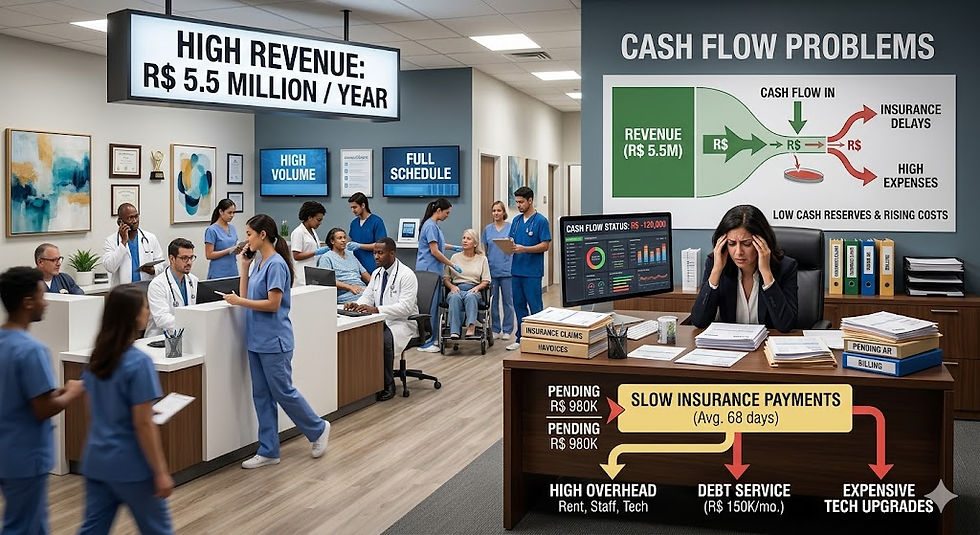
Why Private Clinics Fail Financially Even With Full Schedules


The Hidden Financial Problems That Cause Medical and Dental Practices to Struggle Despite High Patient Demand
At first glance, a fully booked clinic appears to be a successful business.
The waiting room is full. The schedule is packed weeks in advance. Providers are working long hours. Patients continue to arrive every day.
From the outside, everything seems healthy.
Yet many private medical and dental clinics across the United States face a surprising reality: they generate significant patient volume but still experience financial stress, poor profitability, cash flow shortages, and limited growth.
This paradox confuses many physicians, dentists, healthcare executives, and investors. How can a clinic with a full schedule struggle financially?
The answer is simple but often overlooked: activity does not automatically create profitability.
Many healthcare businesses focus heavily on patient acquisition and appointment volume while neglecting the operational and financial drivers that determine whether those appointments actually generate sustainable profits.
This article explores the most common reasons why private clinics fail financially despite high demand, and what healthcare leaders can do to avoid these traps.
The Dangerous Assumption: Busy Means Profitable
One of the biggest misconceptions in healthcare management is the belief that a full schedule equals financial success.
In reality, patient volume is only one component of financial performance.
A clinic can:
See hundreds of patients each month
Generate millions in annual revenue
Maintain strong local reputation
Operate at full capacity
And still produce disappointing financial results.
The reason is that profitability is determined by what remains after costs, inefficiencies, and operational leaks are accounted for.
Revenue alone does not tell the full story.
A clinic generating $3 million annually with a 5% operating margin is in a much weaker position than a clinic generating $2 million annually with a 25% operating margin.
The difference lies in management, not volume.
Revenue Growth Often Hides Structural Problems
Many clinic owners celebrate revenue growth without examining whether the underlying business model is improving.
Consider two scenarios:
Clinic A
Annual Revenue: $5 million
Operating Margin: 4%
Physician Dependency: High
Clinic B
Annual Revenue: $3.5 million
Operating Margin: 22%
Physician Dependency: Moderate
Although Clinic A generates significantly more revenue, Clinic B is financially healthier and often worth considerably more in a valuation.
Revenue can create the illusion of success while masking serious operational weaknesses.
The Cost Structure Problem
One of the most common reasons private clinics struggle financially is poor cost management.
Healthcare organizations frequently focus on increasing appointments rather than controlling expenses.
Common cost issues include:
Excessive Staffing
Many clinics hire reactively instead of strategically.
As patient demand increases, additional employees are added without evaluating productivity metrics.
Over time, payroll becomes one of the largest threats to profitability.
A difference of just 5% to 10% in labor efficiency can significantly impact annual earnings.
Underutilized Resources
Some clinics invest heavily in:
Equipment
Technology
Office space
Additional providers
Without generating enough incremental revenue to justify the investment.
An expensive asset that remains partially idle becomes a financial burden rather than a competitive advantage.
Supply Chain Inefficiencies
Medical supplies, implants, disposable materials, and pharmaceutical inventory often represent substantial expenses.
Without purchasing controls and inventory management systems, waste becomes inevitable.
Many clinics lose thousands of dollars annually through inventory mismanagement alone.
Insurance Reimbursement Challenges
In the United States, reimbursement pressure continues to affect healthcare providers.
Many clinics remain dependent on payer contracts that provide limited margins.
A full schedule filled with low-reimbursement appointments may create activity without profitability.
This issue is especially common in:
Primary care
Physical therapy
Behavioral health
Certain specialty practices
A clinic may be operating at 95% capacity while generating margins that are insufficient to support long-term growth.
The problem is not volume.
The problem is reimbursement economics.
The Productivity Illusion
Providers often assume they are highly productive because they work long hours.
However, productivity should be measured by outcomes rather than effort.
Key questions include:
How much revenue is generated per provider hour?
How much profit is generated per provider hour?
How many appointments result in additional services?
What percentage of patients complete recommended treatment plans?
A clinic can be extremely busy while operating inefficiently.
Long hours do not guarantee strong financial performance.
Failure to Measure Key Performance Indicators
Many private clinics operate with limited visibility into their financial performance.
Owners review:
Monthly revenue
Bank account balances
Payroll expenses
But fail to track the metrics that truly drive profitability.
Critical KPIs include:
Financial Metrics
Gross Revenue
Net Revenue
EBITDA
Operating Margin
Accounts Receivable Days
Operational Metrics
Provider Utilization
Schedule Fill Rate
Patient Retention
No-Show Rate
Commercial Metrics
Conversion Rate
Treatment Acceptance Rate
Patient Acquisition Cost
Without these indicators, leaders make decisions based on assumptions rather than data.
The Hidden Threat of Physician Dependency
Many clinics are built around a single high-performing physician or dentist.
Initially, this creates growth.
Eventually, it creates risk.
Symptoms of excessive physician dependency include:
Revenue concentrated in one provider
Patients attached to one clinician rather than the brand
Limited delegation
Lack of standardized processes
This model often reaches a growth ceiling.
More importantly, it significantly reduces enterprise value.
Investors and buyers place higher valuations on businesses that can operate independently of the founder.
Case Study: A Busy Clinic With Weak Financial Performance
Consider a hypothetical multispecialty clinic.
Performance Metrics
Annual Revenue: $4.8 million
Monthly Patient Visits: 2,200
Schedule Utilization: 92%
At first glance, the clinic appears successful.
However, a deeper analysis reveals:
Payroll consuming 42% of revenue
Operating margin below 6%
High provider dependency
No formal budgeting process
Significant patient leakage
After implementing:
Financial dashboards
Scheduling optimization
Provider productivity tracking
Cost control initiatives
The clinic increased operating margin from 6% to 19% within 18 months.
Patient volume remained largely unchanged.
The difference came from management improvements.
The Cash Flow Trap
Many clinics confuse revenue with cash flow.
A clinic may report strong monthly revenue while struggling to meet obligations because:
Insurance claims remain unpaid
Patient balances are uncollected
Accounts receivable continue growing
Cash flow problems frequently emerge before profitability issues become visible.
Common warning signs include:
Increasing credit line usage
Delayed vendor payments
Difficulty funding growth initiatives
Revenue without cash flow creates financial instability.
Poor Pricing Strategies
Another overlooked issue involves pricing.
Many clinics fail to review fee schedules regularly.
As labor, rent, insurance, and supply costs increase, pricing often remains stagnant.
Over time, margins shrink.
This is particularly problematic in:
Dental practices
Aesthetic clinics
Concierge medicine
Specialty services
Regular pricing reviews are essential for maintaining profitability.
Lack of Strategic Positioning
Many healthcare providers compete primarily on convenience or price.
This creates downward pressure on margins.
The most financially successful clinics often compete on:
Expertise
Outcomes
Patient experience
Specialized services
Strategic differentiation allows organizations to command stronger pricing and attract higher-value patients.
Technology Without Strategy
Healthcare technology can improve performance.
However, technology alone does not solve management problems.
Many clinics invest heavily in:
Electronic Health Records
CRM platforms
Scheduling software
Marketing automation
Without changing workflows.
The result is higher expenses without measurable improvement.
Technology must support a defined operational strategy.
Insights Few Clinic Owners Consider
More Patients Can Actually Reduce Profitability
If low-margin services dominate the schedule, increased volume may increase workload without improving earnings.
Revenue Growth Can Hide Declining Margins
Many clinic owners focus on top-line growth while ignoring deteriorating profitability.
The Best Growth Often Comes From Existing Patients
Improving retention, treatment acceptance, and patient experience often generates stronger returns than acquiring new patients.
A Smaller, More Efficient Clinic Can Be More Valuable
Valuation is driven by profitability, scalability, and risk—not simply revenue volume.
Common Financial Mistakes Made by Private Clinics
Focusing Only on Revenue
Consequence:
Poor visibility into profitability.
Ignoring Cost Structure
Consequence:
Margin erosion despite increasing patient volume.
Failing to Track KPIs
Consequence:
Delayed decision-making.
Excessive Founder Dependency
Consequence:
Limited scalability and reduced valuation.
Neglecting Cash Flow Management
Consequence:
Financial stress despite strong revenue performance.
What Financially Healthy Clinics Do Differently
Successful clinics typically share several characteristics:
Strong financial reporting
Clear performance indicators
Efficient staffing models
Strategic pricing
Process standardization
Diversified provider teams
Controlled cost structures
They focus not only on attracting patients but also on converting activity into sustainable profit.
Conclusion
A full schedule is not a guarantee of financial success.
Many private clinics fail financially because they confuse activity with profitability. Patient volume, while important, is only one element of a healthy healthcare business.
Sustainable success requires a deeper understanding of operational efficiency, cost management, reimbursement strategy, provider productivity, and financial performance.
Healthcare leaders who focus exclusively on growth often discover that bigger organizations can become more complex and less profitable.
The clinics that thrive long term are those that balance growth with disciplined management, strong financial oversight, and strategic decision-making.
In today's healthcare environment, profitability is not determined by how busy a clinic appears.
It is determined by how effectively that activity is converted into financial results.